Introduction
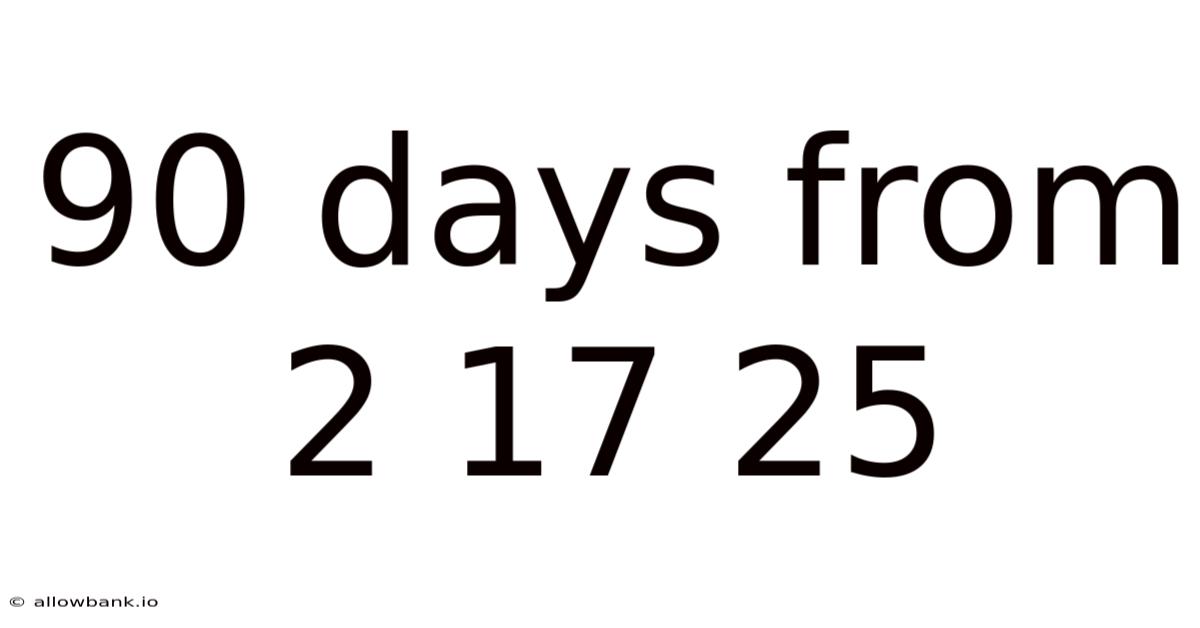
Understanding how to count 90 days from 2 17 25 is a practical skill that appears in many everyday scenarios, from planning projects and scheduling appointments to forecasting deadlines in business and education. Practically speaking, this article explains the step‑by‑step method to determine the exact calendar date that falls ninety days after February 17, 2025, explores the underlying calendar principles, and answers frequently asked questions. By the end of the reading, you will be able to perform similar calculations confidently, without relying on external tools.
Steps
To find the date that is 90 days from 2 17 25, follow these clear steps. Each step is written as a concise action item, making the process easy to replicate Surprisingly effective..
- Identify the starting date – In this case, the start date is February 17, 2025.
- Determine the number of days remaining in the starting month – February 2025 has 28 days (2025 is not a leap year). Subtract the start day: 28 − 17 = 11 days remaining.
- Subtract the remaining days from the total – 90 − 11 = 79 days still need to be counted.
- Add full months until the remaining days are less than the next month’s length –
- March (31 days): 79 − 31 = 48 days left.
- April (30 days): 48 − 30 = 18 days left.
- Place the remaining days into the next month – The 18 days fall in May, so the final date is May 18, 2025.
Result: 90 days from 2 17 25 lands on May 18, 2025.
Scientific Explanation
The Gregorian Calendar
The calculation relies on the Gregorian calendar, the most widely used civil calendar today. This system accounts for the fact that a solar year is approximately 365.Now, 2422 days long. So naturally, to keep the calendar aligned with Earth’s orbit, a leap year adds an extra day (February 29) every four years, except for years divisible by 100 but not by 400. Since 2025 is not a leap year, February contains only 28 days, which influences the count.
Why 90 Days Matters
Ninety days represent roughly three months, but because months vary in length (28‑31 days), the exact date cannot be guessed without a precise count. Understanding the distribution of days helps avoid common errors such as assuming every month has 30 days.
Leap Year Considerations
If the starting year were a leap year (e.g.Here's the thing — , 2024), February would have 29 days, altering the remaining‑days calculation. In such cases, the extra day shifts the final date by one day later in the subsequent month. The method described above automatically adjusts for this by first checking the actual length of the starting month And that's really what it comes down to. No workaround needed..
FAQ
**Q1:
Q1: Does "90 days from February 17" include the starting day? No. The standard convention counts the start date as day zero and begins counting from the next day. If you instead want to include February 17 itself as day one, the result shifts back by one day to May 17, 2025. Always clarify which convention is intended when precision matters, such as in legal or contractual deadlines Practical, not theoretical..
Q2: Is the result the same as "three months later"? Not necessarily. Three calendar months after February 17 would be May 17, while 90 days lands on May 18. This one-day difference arises because February, March, and April together contain 89 days, not 90. This is precisely why counting actual days is more reliable than approximating with months.
Q3: How would the answer change in a leap year? If you started from February 17, 2024 (a leap year), February would have 29 days, leaving 12 remaining days instead of 11. After subtracting March (31) and April (30), you would have 90 − 12 − 31 − 30 = 17 days, landing on May 17, 2024. The extra leap day pulls the result one day earlier relative to the month count Easy to understand, harder to ignore..
Q4: What if the 90-day span crosses into a new year? The same method applies. Continue subtracting full months in sequence—including the varying lengths of each—until fewer days remain than the next month contains. The only added care is remembering that December has 31 days and that the year increments when you pass into January No workaround needed..
Q5: Can I use this method for any number of days? Yes. The technique is universal: subtract the days left in the starting month, then subtract each full month's length in order, and place whatever remains into the final month. Whether the target is 30, 100, or 365 days, the process is identical It's one of those things that adds up..
Conclusion
Determining the date 90 days from 2 17 25 comes down to a simple, repeatable process: account for the days left in the starting month, subtract the length of each subsequent month, and place the remainder into the final month. For February 17, 2025, this yields May 18, 2025. Consider this: the key insight is that months are not uniform—their lengths range from 28 to 31 days—so accurate results depend on counting actual days rather than estimating with fixed 30-day blocks. By mastering this method and staying mindful of leap years and counting conventions, you can confidently forecast deadlines, schedule projects, and plan ahead for any date in the calendar, all without reaching for a calculator or app Turns out it matters..
It sounds simple, but the gap is usually here.
