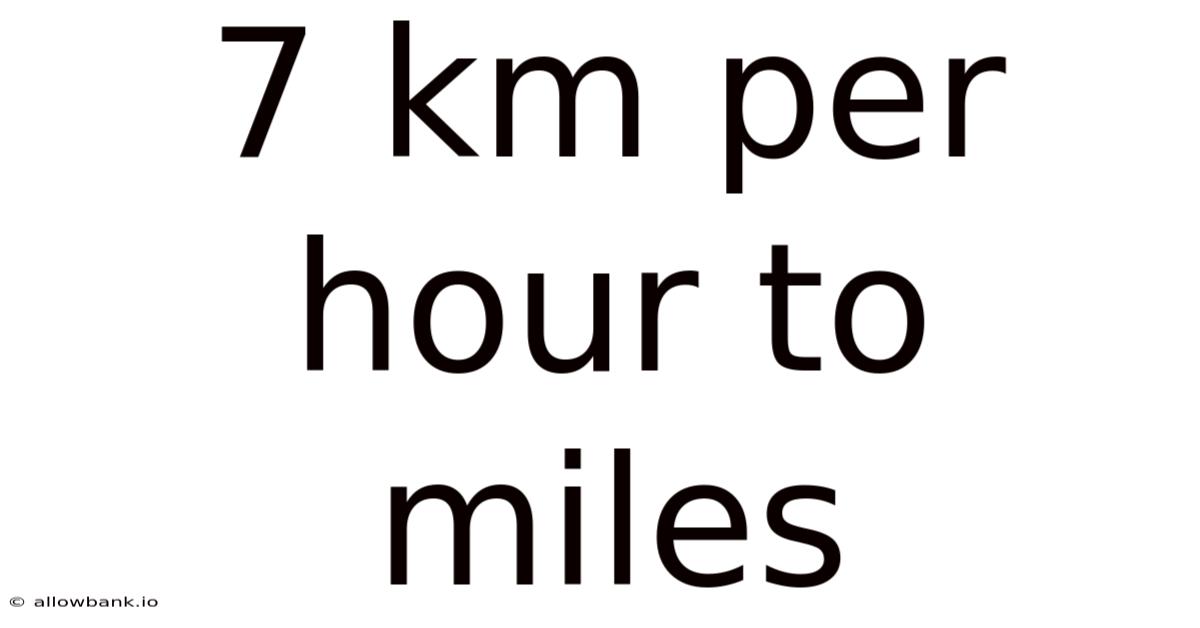
Understanding the conversion between kilometers per hour and miles per hour is a fundamental skill for anyone navigating international travel, fitness tracking, or scientific data. When looking at a specific value like 7 km per hour to miles, the precise answer is approximately 4.35 mph. That said, the context surrounding this number—whether you are setting a treadmill pace, reading a foreign speed limit sign, or analyzing athletic performance—adds layers of practical importance that a simple calculator output cannot provide.
The Exact Conversion: 7 km/h to mph
To understand where the number comes from, we must look at the defined relationship between the kilometer and the mile. By international agreement, one mile is exactly 1,609.344 meters, while one kilometer is exactly 1,000 meters Not complicated — just consistent..
Honestly, this part trips people up more than it should Most people skip this — try not to..
$ 1 \text{ km} \approx 0.62137119 \text{ miles} $
Applying this to 7 km/h:
$ 7 \times 0.62137119 = 4.34959833 \text{ mph} $
For almost all practical purposes, rounding to 4.Day to day, 35 mph is standard. Here's the thing — 3 mph** or even **4. On the flip side, in casual conversation or quick mental math, 4. 4 mph is often used, but precision matters in calibration and pacing.
Why This Specific Speed Matters: The "Brisk Walk" Threshold
The value of 7 km/h (4.35 mph) occupies a unique physiological sweet spot. It sits precisely at the boundary between a very brisk walk and a slow jog for the average adult Easy to understand, harder to ignore. That's the whole idea..
1. Fitness and Health Guidelines
Major health organizations, including the World Health Organization (WHO) and the CDC, classify physical activity by intensity.
- Moderate Intensity: Typically 4.8 to 6.4 km/h (3–4 mph).
- Vigorous Intensity: Typically > 6.4 km/h (> 4 mph) or a pace where talking is difficult.
At 7 km/h, most healthy adults transition from moderate to vigorous intensity. It is a common target speed for "power walking" programs designed to maximize cardiovascular benefit without the joint impact of running. If you set a treadmill to 7 km/h, you are effectively training at the upper limit of walking efficiency.
2. Treadmill Calibration and Gym Standards
Gym equipment worldwide varies by region of manufacture. Treadmills built for the US market default to miles per hour (mph), while European and Asian models default to kilometers per hour (km/h) It's one of those things that adds up..
- Scenario: A user follows a workout plan written in km/h (e.g., "Walk at 7 km/h for 30 mins") but stands on a US-calibrated treadmill.
- Action: They must input 4.35 mph (often rounded to 4.3 or 4.4 on the console).
- Error Risk: Inputting 7.0 mph (11.26 km/h) would result in a fast run, potentially causing injury or exhaustion. Knowing the 7 km/h to mph conversion prevents this common safety hazard.
3. Running Pace Conversion (Minutes per Mile vs. Min/km)
Runners often think in pace (time per distance) rather than speed (distance per time). Converting 7 km/h to pace yields:
- Pace per km: 8:34 min/km
- Pace per mile: 13:47 min/mile
This 13:47 min/mile pace is a popular goal for beginner half-marathon training programs (often called the "sub-3 hour half marathon" pace, which is actually slightly faster at ~13:43/mile, but 7 km/h is the standard metric approximation used in many European training plans like those by Runner's World Germany or Laufcampus).
The Mental Math: Estimating Without a Calculator
You won't always have a conversion tool handy. Here are three reliable mental shortcuts for converting km/h to mph, tested against the 7 km/h benchmark.
Method 1: The "Divide by 1.6" Rule (Most Accurate)
Since 1 mile ≈ 1.609 km, dividing km/h by 1.6 gives a very close estimate.
- Calculation: $7 \div 1.6 = 4.375$ mph.
- Error: +0.025 mph (negligible).
Method 2: The "Fibonacci" Trick (For Whole Numbers)
The Fibonacci sequence (1, 1, 2, 3, 5, 8, 13, 21...) approximates the mile/km ratio because the ratio of sequential numbers approaches the Golden Ratio (~1.618), close to the 1.609 conversion factor.
- Logic: 5 km ≈ 3 miles; 8 km ≈ 5 miles.
- Application for 7 km/h: 7 is between 5 and 8. The mph equivalent is between 3 and 5. Roughly 4 mph. It’s a rough estimate, good for highway speeds (80 km/h ≈ 50 mph), less precise for 7 km/h.
Method 3: The "Multiply by 0.62" (Standard Approximation)
- Calculation: $7 \times 0.6 = 4.2$; $7 \times 0.02 = 0.14$; Total = 4.34 mph.
- Verdict: This is the best "pen-and-paper" method for high accuracy.
Comparative Speed Context: Visualizing 4.35 mph
Numbers are abstract. Comparing 7 km/h (4.35 mph) to familiar speeds helps internalize the velocity.
| Activity / Object | Speed (km/h) | Speed (mph) | Comparison to 7 km/h |
|---|---|---|---|
| Average Human Walking | 5.5 | 4.0** | **4.1 |
| Brisk Walk / Power Walk | 6.But 5 – 7. 35** | Benchmark | |
| Slow Jog / Shuffle | 8.Practically speaking, 7 | Equivalent Zone | |
| 7 km/h (Target) | **7. Still, 0 – 4. 0 | 3.0 | 5. |
This table illustrates that 7 km/h is a distinctly human speed—fast for walking, slow for running, and pedestrian for vehicles Simple, but easy to overlook. Took long enough..
Practical Applications in Daily Life
International Travel and Car Rentals
Renting a car in Europe, Australia, or Canada (where speed limits are in km/h) with a US driver's license requires instant conversion.
- Urban Limit (50 km/h): ~31 mph.
- Rural Limit (80–90 km/h): ~50–56 mph.
- **High
