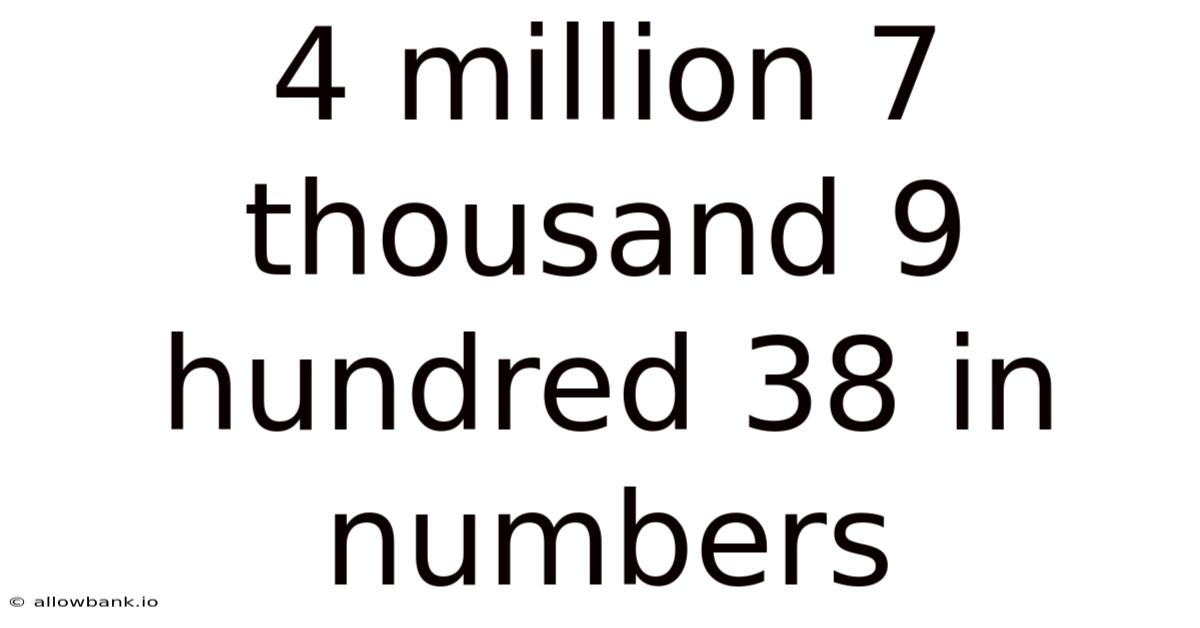
4 million 7 thousand 9 hundred 38 in numbers is a phrase that often appears in math homework, financial documents, or data reports, yet many people pause when asked to write it digit by digit. The process of converting words to numerals is more than just a mechanical task; it is a gateway to understanding how our number system organizes value across millions, thousands, and units. When we break down “4 million 7 thousand 9 hundred 38,” we are essentially mapping language onto the place value system that powers everyday arithmetic. This article provides a clear, step-by-step guide to writing this number in digits, explores the science of place value, and highlights why precision matters in real-world contexts Simple, but easy to overlook..
Introduction: Understanding Large Numbers in Daily Life
Large numbers are an unavoidable part of modern life. Here's the thing — from population statistics and national budgets to scientific measurements and computer storage, we encounter figures in the millions and beyond on a regular basis. The ability to read, write, and interpret these numbers accurately is a foundational skill that supports financial literacy, data comprehension, and logical thinking. When a number is presented in words—such as “4 million 7 thousand 9 hundred 38”—it requires translation into the Hindu-Arabic numeral system most of us use daily. This translation relies on the concept of periods: groups of three digits separated by commas, each period representing a different magnitude of value. Mastering this conversion not only prevents costly errors in documents but also builds confidence when handling any numerical information.
Steps to Convert Words to Digits
Converting a number from word form to digit form follows a logical sequence rooted in place value. Here is a reliable method to write “4 million 7 thousand 9 hundred 38” in numbers:
-
Identify the largest period first. The word “million” signals the start of the millions period. Write the digit(s) that come before “million,” which in this case is 4, and place it in the millions position: 4,000,000.
-
Move to the thousands period. The phrase “7 thousand” indicates 7 in the thousands place. Since there are no hundreds, tens, or ones specified within that immediate segment, we write 7 in the thousands spot, resulting in 4,007,000 so far It's one of those things that adds up..
-
Process the remaining hundreds and units. The remaining part, “9 hundred 38,” consists of 9 hundreds (which is 900) and 38 ones. Adding these to the existing structure gives 900 + 38 = 938. Placing this in the final three digits yields 4,007,938 And that's really what it comes down to..
-
Insert commas for readability. Proper formatting separates each period with a comma: 4,007,938. This visual grouping aligns with how we verbally parse the number and reduces
cognitive load when reading or writing the figure. By following these steps, the verbal description “4 million 7 thousand 9 hundred 38” is accurately transcribed as 4,007,938.
The Science of Place Value: Why It Works
The reliability of this conversion method lies in the base-10 place value system, a cornerstone of mathematics. From right to left, the positions are ones (10⁰), tens (10¹), hundreds (10²), and so on. Each position in a numeral represents a power of ten. The periods—units, thousands, millions—simply group these positions for easier comprehension.
In the number 4,007,938:
- The 4 is in the millions place (10⁶), representing 4,000,000.
- The 7 is in the thousands place (10³), representing 7,000. Now, - The 9 is in the hundreds place (10²), representing 900. Practically speaking, - The 3 is in the tens place (10¹), representing 30. - The 0 in the ten-thousands place indicates there are zero ten-thousands.
- The 0 in the hundred-thousands place indicates there are zero hundred-thousands.
- The 8 is in the ones place (10⁰), representing 8.
Summing these values (4,000,000 + 7,000 + 900 + 30 + 8) confirms the total. This system’s elegance is its scalability; the same principles apply to numbers in the billions, trillions, or any range, making it a universal language for quantifying magnitude Worth keeping that in mind. And it works..
Precision in the Real World: Why It Matters
The ability to accurately convert between word and digit forms is not just an academic exercise; it has tangible consequences. Consider a few scenarios:
- Financial Transactions: A contract or invoice stating “four million seven thousand nine hundred thirty-eight dollars” must be written as $4,007,938. A single misplaced digit or omitted zero could result in a payment being off by millions, leading to legal disputes and financial loss.
- Data and Statistics: In journalism or scientific reporting, figures like “4 million 7 thousand 9 hundred 38” might describe a population, a disease count, or a budget. Precision ensures that the public and policymakers receive accurate information, which is crucial for informed decision-making.
- Technology and Computing: While computers operate in binary, the data they process—file sizes, memory capacities, or financial data—is often displayed in the decimal system we use. Understanding these large numbers is essential for developers, engineers, and anyone interpreting technical specifications.
In each case, clarity and accuracy prevent misunderstanding and develop trust. The habit of double-checking conversions, whether manually or with digital tools, is a simple yet powerful safeguard Small thing, real impact..
Conclusion: Empowerment Through Numerical Literacy
Mastering the conversion of phrases like “4 million 7 thousand 9 hundred 38” into the precise numeral 4,007,938 is more than a mechanical skill; it is a demonstration of numerical literacy. This competency underpins our ability to work through a world saturated with data, from personal budgeting to global economics. By understanding the underlying place value system, we gain confidence in handling numbers of any size, reducing the risk of error and enhancing our capacity to analyze information critically. In an era where data drives decisions, the ability to read, write, and interpret large numbers accurately is not just useful—it is essential for empowerment and informed citizenship.
